Role in Marina Siertis
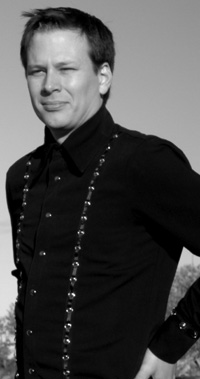
Martin Löfgren is the lead singer of Marina Siertis, as well as songwriter. On the coming album “The much needed second cold war”, most demos were written by Martin, including the current single “The minister is dead”. Martin is maybe the member that most often can be seen in the studio, making new songs, fiddling around with details in song arrangements, recording guitar that anyhow most often needs to be re-recorded by the other Martin, and generally messing around with music.
Musical background
With a mother teaching music in compulsory school, music has always been around in Martin’s life. As young he tried many instruments: piano, clarinet, drums, flute, accordion, guitar, and basically everything lying around in the home. The first real training with an instrument was with cello, as a substitute for contra bas that was a too large instrument at the time.
Back in 1991 (or possibly 1992) Martin was given his first synthesizer by his mother (the ever beloved Roland U-20), as well as his first sequencer program and computer (Notator 3.0 and Atari 1040 STE). Shortly thereafter Martin started the band Frontloading, together with Anders Larsson and Jonas Andersson.
After never really having finished a song, the band changed name to Innocentia at about the same time as Jonas in essence withdrew from the band. After a while André Öberg joined the band, after impressing with demo songs from his own project ART. Innocentia managed to make a full-length 14 tracks tape “Racerbil” (released in amazing 50 copies). Martin was the songwriter to most of the songs on the tape and also did most of vocal.
After the “release” of the tape (this was in 1995 or so, which means no internet, no mp3 etc.) the band again changed name, this time to Marina Sirtis. The name suggestion was inspired by “Yvonne” and although the Innocentia tape contained one or two songs concerning space, and although S.P.O.C.K. was a favourite band at the time, the band Marina Sirtis was never really meant to be associated with Star Trek. Under the name Marina Sirtis (back in 2000) the first release with a hint of quality was released, the EP “View from an Intergalactic Star”. On this EP the songwriting by Martin was rested, for the benefit of André’s songs. On the debut album “Delay and depression”, which was recorded in Martin’s living room to the complaint of the neighbours, again the better part of the songs were written by André while Martin and Anders focused on arranging and producing the songs.
“Delay and Depression” was released on the label “Shadowplay Electronica” (which ironically also changed name to Shadowplay Music) and Martin was one of the founders of the label. Also at the time (2003), Martin was one of the driving forces behind the Sputnik Festival 2003 in Stockholm. This festival left a tearing whole in the bank account but on the upside, guitarist Martin Fridgren was gained for the band.
After the Sputnik Festival, many years have been spent in the studio (after Delay and Depression the neighbours complaints escalated to the point where the living room had to be evacuated and a proper location had to be found for the band). Finally new music is being released. This time Martin has one again taken the helm at writing demos. During this time, Martin has also appeared on a Jonny Kock cover album among other things.
Musical influences
Martins musical childhood was a mixture of what his mother and oldest brother enjoyed, which is all sorts of classical music (mom) and “Dolly Parton” country (brother). Thereafter, the middle brother introduced hard rock, such as AC/DC, Kiss, Twisted Sisters etc. Martins first own LP was Europe’s “The Final Count Down”.
After getting tired at hard rock (at about the age of 12), artists like Dire Straights, U2, and Bruce Springsteen were postered on the walls of his room. At about 14 or 15 Martin was introduced to bands like Depeche Mode, The Cure, Erasure, etc, mostly by “to become” band member Anders. For along time, such music (synthpop/post punk/goth etc.) was the only music existing. Nowadays the musical influences have somewhat diverged from the “we can only use electronic sounds”-music. To list some of the most important:
Radiohead, Björk, Depeche Mode, Tindersticks, The Cure, Thåström, Gary Numan, Coldplay, Mira, Queens of the Stone Age, Siouxie and the Banshees, Weeping Willows, Mesh, Portishead, Twice a man, and many, many more. |
 |